Model Context Protocol Explained in 3 Levels of Difficulty
MCP provides a standard way for AI applications and external systems to communicate.

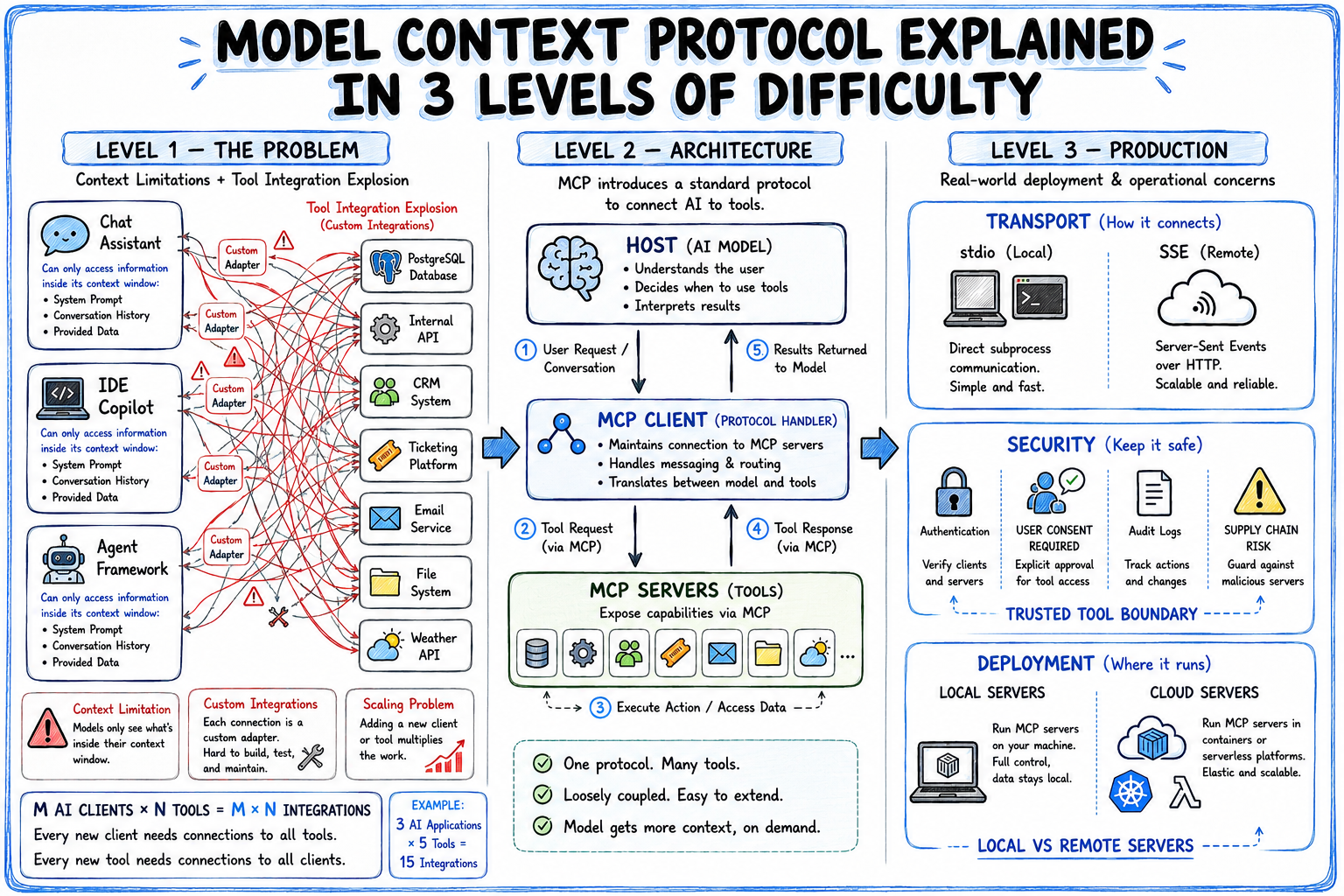
MCP provides a standard way for AI applications and external systems to communicate.

This article is divided into three parts; they are: • Floating-point Numbers • Automatic Mixed Precision Training • Gradient Checkpointing Let’s get started! The default data type in PyTorch is the IEEE 754 32-bit floating-point format, also known as single precision.
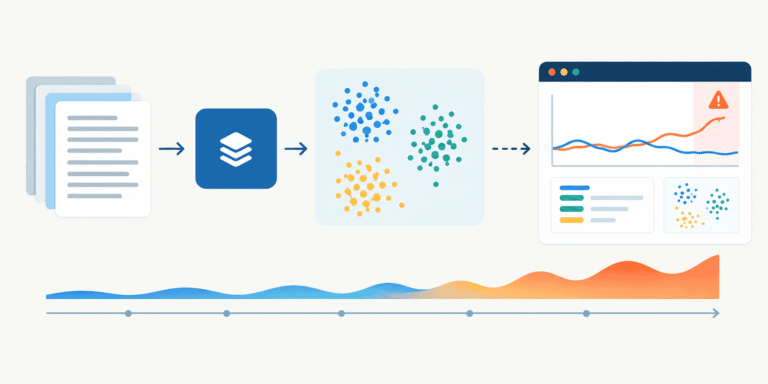
In this article, you will learn what embedding drift is, why it matters for production large language models, and how to implement two practical techniques…
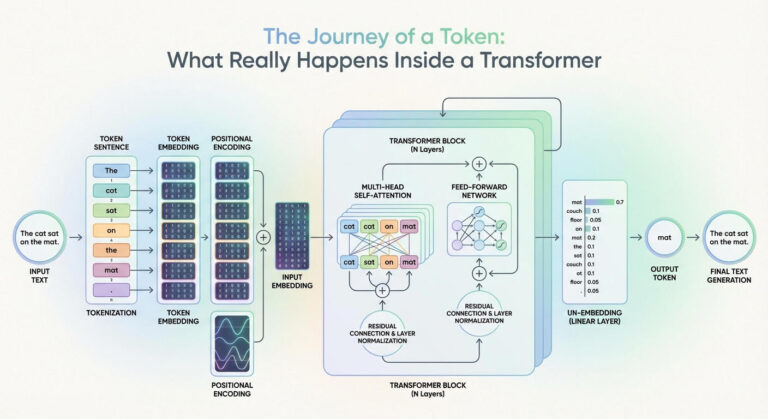
Large language models (LLMs) are based on the transformer architecture, a complex deep neural network whose input is a sequence of token embeddings.

This post is divided into three parts; they are: • Interpolation and Extrapolation in Sinusoidal Encodings and RoPE • Interpolation in Learned Encodings • YaRN for Larger Context Window Sinusoidal encodings excel at extrapolation due to their use of continuous functions: $$ begin{aligned} PE(p, 2i) &= sinleft(frac{p}{10000^{2i/d}}right) \ PE(p, 2i+1) &= cosleft(frac{p}{10000^{2i/d}}right) end{aligned} $$ You…
When we ask ourselves the question, ” what is inside machine learning systems? “, many of us picture frameworks and models that make predictions or perform tasks.

One of the claims made by OpenAI regarding its latest model, GPT-5 , is a breakthrough in reasoning for math and logic, with the ability to “think” more deeply when a prompt benefits from careful analysis.